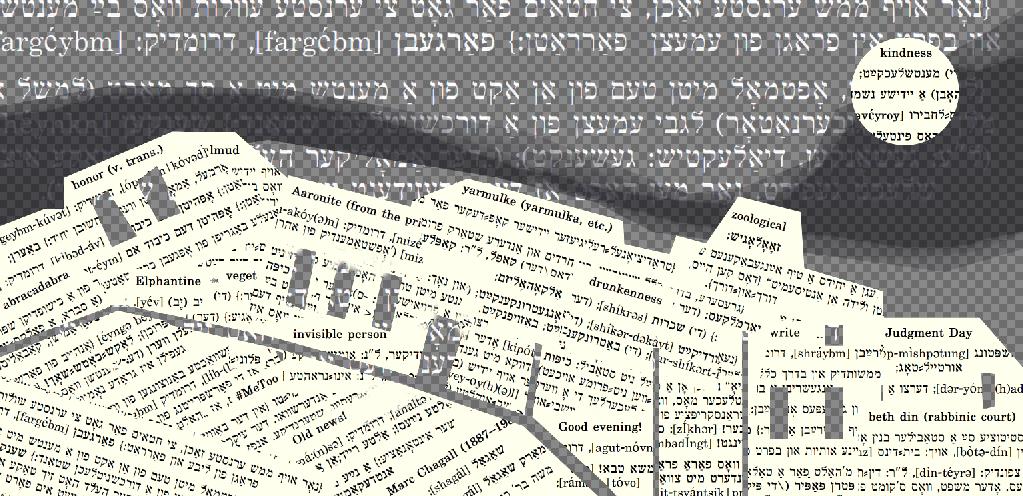
YCD MONTAGE BY GIEDRĖ BECONYTĖ
The Yiddish Cultural Dictionary, known as ווילנער ווערטערבוך in Yiddish, is a continuously browsable, book-style online English–Yiddish dictionary. It combines the convenience of digital searching with the traditional experience of reading a dictionary in alphabetical sequence. Rather than presenting words as isolated search results, every search takes the reader directly to the word sought within the continuous alphabetical text of the dictionary, with the surrounding entries visible above and below it. Readers can browse freely by scrolling up and down or by using the page-turning buttons at the bottom of the screen, where the current entry count is also displayed. This encourages the discovery of words, expressions, meanings and cultural associations beyond those originally sought. The dictionary is entirely free to use, without registration, subscription or limits on access, and is continuously expanded, revised and corrected during the author's lifetime. All the notes and usage indicators are, as a matter of principle at the very core of the project, entirely in Yiddish.
YCD was initiated in January 2018 in Vilnius, Lithuania (first Facebook announcement). It welcomes suggestions from colleagues, students and general readers concerning missing words, as well as reports of errors of any kind. By autumn 2026, YCD comprised 52,500 main entries, 1.17 million words of text including 1,800 notes (all in Yiddish) on usage, stylistics, nuance, etymology, social history and the lively debates of today's Yiddish world. To find these notes, enter הערה in the search box; for cautions, enter אזהרה. Readers from far and wide have assisted the project by sending corrections and suggestions (via info@yiddishculturaldictionary.com).
Digital history: initiated in Jan. 2018 at: www.defendinghistory.com/yiddish-cultural-dictionary. Moved in June 2018 to: www.yiddishculturaldictionary.org (wordpress html), with IT design by Andrius Balčiūnas (Vilnius). Transitioned gradually in late 2025 and early 2026 to www.yiddishculturaldictionary.com (json), designed by Matouš Havránek (Prague), and since developed by Petr Polák (Prague).
Preface
Yiddish is among the most majestic of the world's stateless languages. It is a thousand years old, arising in central Europe at the dawn of Ashkenazic Jewish civilizaion, and later relocated to Eastern Europe, and then from the late nineteenth century to a range of overseas destinations, most numerously America. Over a century and a half, its modern literature gave the world a unique literature comparable in scope and achievement to the national literatures of a number of European countries. The Holocaust destroyed Ashkenazic Yiddish life in its homeland. Now, approaching the middle decades of the twenty-first century, it has around a million Haredi (mostly Hasidic) speakers, and a few thousand competent speakers in secular circles, and while discarded by many in the shadow of modern Israeli Hebrew and Jewish English, it continues like a magnet to draw its passionate devotees, some of whom take the time and trouble to truly master and use the language.
Statelessness is a multisided situation, capable of unleashing vast personal creativity and societal energy while also giving rise to an array of obstacles, including issues of usage, fragmentation and disputes over many matters that languages with armies and state schools do not experience, not to mention arguments about the language’s validity, necessity, future and worth. Some see the resultant linguistic diversity as a malaise that calls for corrective intervention by a centralized authority. Whatever your views, if you are seriously studying Yiddish, please do not limit yourself to any one dictionary!
A Yiddish cultural dictionary is one in which Jewish culture of all ages, in all its startling diversity, takes center stage. The dictionary seeks to portray its embedding in the words, expressions and sounds of the Yiddish language. Naturally, the emphasis is on concepts, personalities and history that play a role in Ashkenazic Jewish civilization. The aim is to enable the reader to achieve a more intimate understanding of the Ashkenazic Yiddish ethos. It is not monolithic and this work hopes to give fair and equal expression to its many different subcultures. These subcultures are not seldom in conflict with each other, giving rise to colorful and hearty, sometimes earthy emotive expressions, which are embraced and presented. The Yiddish conceptualizations (and pronunciations) of Jewish historical, religious and cultural concepts start with Genesis and reach the burning Jewish issues of our times.
More than any other chapter in Jewish history and lore, it is Yiddish itself that is emphasized most. To pinpoint how Yiddish usage may reflect the ideology and givens of the wide spectrum of today's Jewish world. Many of the notes concern disputed usages, etymologies, and the nuance of divergent use, as well as the history of the Yiddish language and its culture. The vast majority are things that so many Yiddish speakers themselves have thought and spoken about, and continue to think and speak about. They have themselves become part of the linguistic-cultural complex that is Yiddish, and that the dictionary hopes to introduce to readers.
At the same time, this work looks with wonderment at the truly organic rise of the standard literary language, whose profoundly systematic and meaningful internal variation is reflected in the different language islands around the world. For YCD, respect for the diversity of Yiddish is inseparable from respect for a larger linguistic unity achieved. By citing standard forms first, the dictionary supports that standard. Dialect forms are cited immediately afterwards, encouraging those who wish to adhere to the usage of one of the dialect areas, each of which is simultaneously a culture area. The major divide is between the South (Poland, Ukraine, Hungary and surrounding countries), and the North (the Litvaks, with Belarus and Lithuania the heartland). Since the Holocaust, these dialect and cultural areas have lived on tenaciously in the minds, speech and writing of speakers and entire communities far removed from their original territories in Eastern Europe. By documenting ideological, religious, political and cultural conflicts, the work hopes to bring to life through words and forms the inspirational diversity that constitutes, perhaps surprisingly to some, a single larger structural whole. An example for stateless languages everywhere.
The specific vibrancy and humor of Yiddish are inimitable, and its speakers and written works span a spectrum from some of the most religious groups to some of the most radical. The Yiddish Cultural Dictionary aims to stake out a broad middle ground while including variants from all the wings and factions, and offering commentary openly from the compiler's perspective, clearly identified as such by squiggly brackets { }, whose contents, entirely in Yiddish, may provoke diverse reactions, which are themselves part and parcel of the lively discourse. Or, to put it differently, the humble { } brackets come to tell the reader that all that is therein is the author's opinion, not God's honest normativist truth.
The hope is that a one-way dictionary from another language to Yiddish may inspire users to speak and write in Yiddish, not only about Yiddish, and to be drawn into the enchanting milieu of Yiddish from the inside, rather than merely acquiring vocabulary and grammatical rules. If there is a single overriding goal, it is Yiddish as a living, exciting language. It may be full of pleasures, but it needs to be mastered like any other language, not objectified as a prop for any of a number of external causes or as a presumed shortcut to the deeper understanding of a culture where language sits at the very core.
Seeking to complement rather than duplicate existing dictionaries, YCD is rooted in descriptivism and variationism rather than normativism and purism, and in traditionalism and the search for the Yiddish spirit of things, rather than in reform, radicalism or replacement. It seeks to bridge the frighteningly wide divide between living Hasidic (Haredi) Yiddish (and the remnants of bona fide secular Yiddish), on the one hand, and, on the other, the Yiddish of primers, classes, clubs and online chat spaces where actual Yiddish usage is sometimes delegitimized. The goal is to make a modest contribution toward the reunification of Yiddish as the twenty-first century rolls along. YCD contends that the spirit of Yiddish as used by the great literary masters of the twentieth century and by the last generation of native speakers born before the Holocaust lives on in an inclusive, middle-of-the-road Yiddish stylistics that acknowledges the different wings of the language: religious and secular, traditional and radical, standardist and dialect-oriented.
“Reunification” here does not imply an attempt to make literary standard Yiddish and the emerging new Hasidic standard identical. That would be neither possible nor desirable. It does, however, imply a return to the mainstream tradition of literary Yiddish (the real Standard Yiddish / כלל⸗יידיש), which is historically a much broader tent and one much closer to Hasidic Yiddish than the ultranormativist, purist, Ausbauist alternative. The latter, in YCD's view, is on the cusp of bringing about the emergence of two separate Yiddishes: a living language and an academic experiment whose institutional success appears inversely related to the survival of native speech communities (see the entry Ausbauism). Put differently, the aim of recognizing different dialects and varieties within one language is at odds with the deliberate promotion of linguistic separation and the attempted construction of clublects, familylects and Yiddish101lects. YCD aims to record thousands of items through which religious and secular Yiddish may continue to enrich each other, as they have done for centuries. Moreover, YCD regards Ashkenazic Hebrew and Aramaic as age-old founts of enrichment for Yiddish, particularly in its more formal and learned (and occasionally humorous) registers, and seeks to renew a tradition abandoned by many twentieth-century secularist movements and the dictionaries associated with them.
Another Ausbauism-related issue concerns the very real challenge of finding equivalents for the most modern words in circulation in the 2020s. That challenge is embraced. It must not be shirked. But equivalents are sought that are in harmony with the language sensibilities of native speakers, which prominently include openness to internationalisms, at least among the variants on offer, rather than a quest to devise Yiddish terms for technology and the sciences that are “specific” (meaning: further from the source language, as Ausbauism demands). That makes little sense with these technologies are not remotely part of Yiddish culture and specificity can arise only from the well of the spoken language over time. This dictionary's notes do not hesitate to critique the "cutie-pie" Yiddish characteristic of many proposals from the Ausbauist camp. Turning to borrowings more generally, many borrowings from English have enriched Yiddish, in the twentieth century in all its communities, and in the twenty-first primarily in Hasidic society. In the true spirit of the history of Yiddish, they develop further within Yiddish, in interplay with the old components of the language, an interplay that brings about, over years of living use, the true specificity of a language.
As a grateful pupil of Elye Bokher, Shiye-Mordkhe Lifshitz, Yehoyesh and Spivak, Alexander Harkavy, Hermann Strack, Zina (Paula) Horowitz, Yisroel Shteynberg, Nokhem Stutchkoff, Yudel Mark, and Baila Roth, with no pretensions of ascension to their level, the compiler hopes that his Vilner Verterbukh will at least be remembered as a dictionary with a soul, with all its faults and errors. Also, that he understood every day how very fortunate he was to live in a time when the goal could even be pursued in his lifetime via the wonders of the internet age, in the absence of support from the established Yiddish institutions in his last years. Moreover, the joy of receiving corrections, critique, argument, and words for inclusion, from Yiddish students, teachers and scholars far and wide, Hasidic editors and authors, Litvak scholars both religious and secular, and a mosaic of diverse internationals, is a genuine inspiration.
Therewith, the hope that some few things here might be of interest to people studying Yiddish a hundred years hence.
Dovid Katz
Vilnius 2026
in memory of my father Menke Katz and to inspire this dictionary’s users to read his poetry in Yiddish, in English, and in translation
compiled with reference to the author’s earlier work in Yiddish stylistics, grammar, linguistics and sociolinguistics, history, dialectology, in situ expeditions, orthography, editing of journals and academic anthologies, original fiction, Bible translation, and other fields of Yiddish; current and recent projects
Vilnius 2026
ווילנער ווערטערבוך
—פון—
דוד קאַץ
צו די ביכער דערציילונגען: הירשע⸗דוד מעינקעס
בווילנא
ווילנא תשפ″ז ווילנע 2026